Friedewald formula: how calculated LDL cholesterol works
Sheenam Midha · Health writer

On this page
The Friedewald formula estimates LDL cholesterol from total cholesterol, HDL cholesterol, and triglycerides. It made routine LDL reporting practical, but calculated LDL is an approximation whose reliability changes with the sample.
Use our LDL calculator to run the equation and view the limitations with your result.
Why LDL is often calculated
Measuring every lipoprotein fraction with reference laboratory methods is slow and expensive. A standard lipid panel already measures total cholesterol, HDL, and triglycerides, allowing LDL to be estimated without a separate complex procedure.
The formula assumes that very-low-density lipoprotein cholesterol can be approximated from triglycerides. That assumption works reasonably in many routine samples and less well in others.
How the Friedewald formula works
When values use mg/dL:
LDL-C = total cholesterol − HDL-C − (triglycerides ÷ 5)
When values use mmol/L:
LDL-C = total cholesterol − HDL-C − (triglycerides ÷ 2.2)
Do not use the divisor from one unit system with values from the other.
Worked calculated LDL example
For total cholesterol 200 mg/dL, HDL 50 mg/dL, and triglycerides 150 mg/dL:
- 150 ÷ 5 = 30 mg/dL estimated VLDL cholesterol
- 200 − 50 − 30 = 120 mg/dL calculated LDL
This is not a direct count of LDL particles and does not reveal LDL size or apoB.
What the triglyceride divisor is estimating
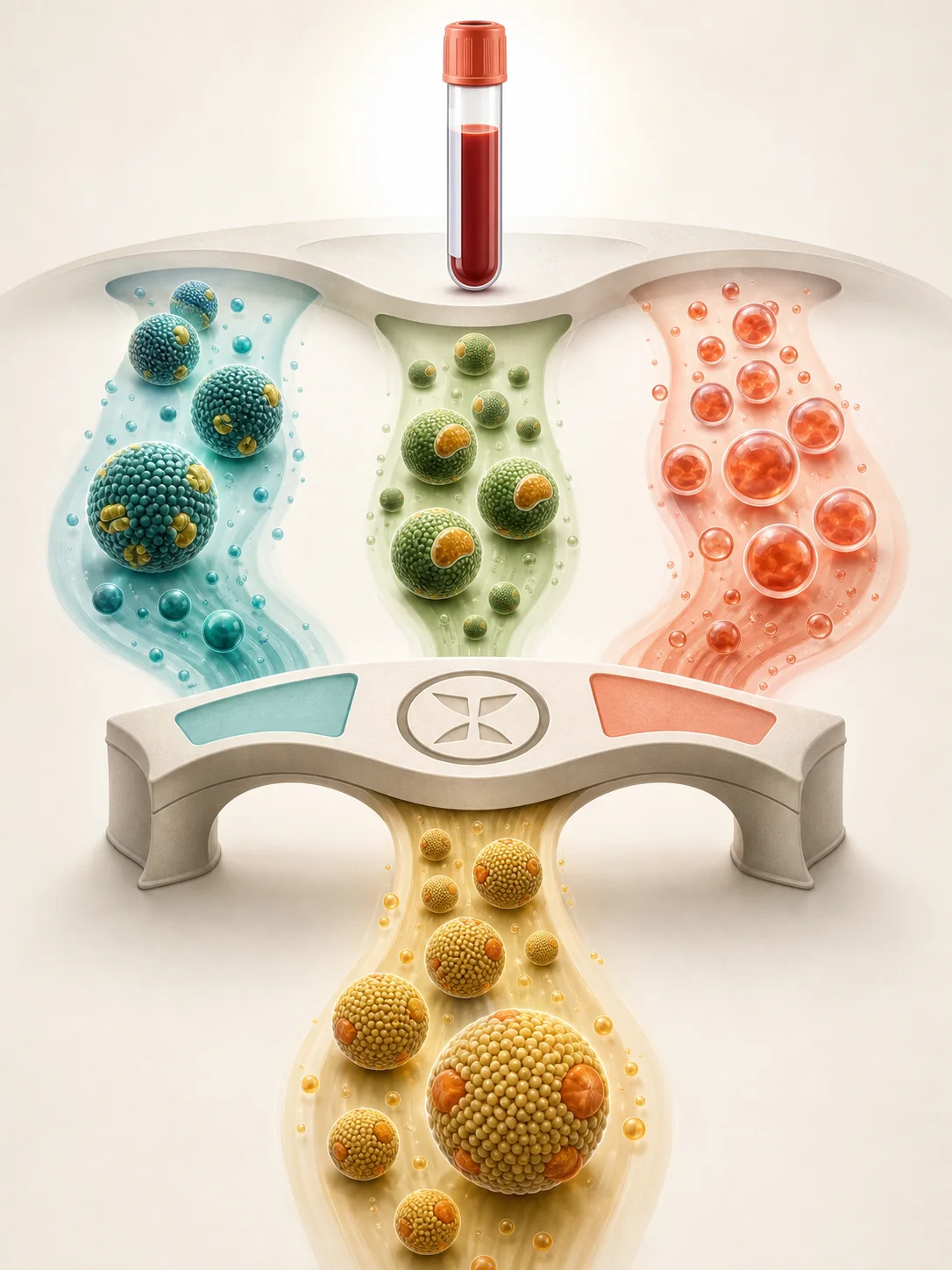
Total cholesterol includes cholesterol carried in several lipoprotein families. In a simplified view, subtracting HDL and an estimate of very-low-density lipoprotein cholesterol leaves LDL cholesterol. The Friedewald equation uses triglycerides divided by 5 in mg/dL as that VLDL-cholesterol estimate.
The divisor is an average relationship, not a law of physiology. The amount of cholesterol carried relative to triglyceride changes across people and across metabolic conditions. When that relationship shifts, the estimated VLDL term is wrong and the error passes straight into calculated LDL.
Suppose the equation subtracts too much estimated VLDL. The reported LDL will be too low. If it subtracts too little, LDL will be too high. The problem becomes more noticeable when triglycerides are elevated or the true LDL is already low because the uncertain term makes up more of the final answer.
Calculating VLDL cholesterol on its own
Some reports print VLDL as a separate line. It is usually this same estimate:
- mg/dL: VLDL-C = triglycerides ÷ 5
- mmol/L: VLDL-C = triglycerides ÷ 2.2
With triglycerides of 150 mg/dL, that’s 30 mg/dL. It tells you nothing about how many VLDL particles you have or how big they are. The divisor of 5 reflects an average seen in the original Friedewald study group, and your own ratio on the day can sit above or below it. Diet, fasting status, insulin resistance, liver fat, alcohol, and some medicines all shift how much triglyceride each particle carries. The formula keeps dividing by 5 regardless.
This is why “calculated” belongs on the report. It tells you how the number was obtained. It does not mean the laboratory was careless, and it does not mean the value should always be replaced with a direct LDL test.
More worked examples
Take a panel with total cholesterol 175 mg/dL, HDL 55 mg/dL, and triglycerides 100 mg/dL. The estimated VLDL term is 20 mg/dL. Calculated LDL is therefore 175 minus 55 minus 20, or 100 mg/dL.
Now keep total cholesterol and HDL the same but raise triglycerides to 250 mg/dL. The equation subtracts 50 mg/dL for estimated VLDL and reports LDL of 70 mg/dL. That lower calculated LDL may look reassuring, yet the sample now sits in a range where the fixed triglyceride-to-VLDL assumption becomes less dependable. Non-HDL remains 120 mg/dL in both examples because it uses only total and HDL.
For mmol/L, consider total cholesterol 5.2, HDL 1.3, and triglycerides 1.5. Divide triglycerides by 2.2 to get about 0.68, then subtract: 5.2 minus 1.3 minus 0.68 gives calculated LDL near 3.22 mmol/L.
Do not convert the final mg/dL answer by dividing by 18. That conversion is used for glucose. Cholesterol uses a different conversion factor, and triglycerides use another one again. The safest approach is to select the unit in a calculator before entering any values.
Why fasting status sometimes matters
Modern lipid testing often uses nonfasting samples because total cholesterol, HDL, and risk assessment can still be useful. The catch is triglycerides. They may rise after a meal, and the Friedewald calculation uses them directly.
A modest nonfasting rise does not automatically invalidate the panel. If triglycerides are unexpectedly high, calculated LDL is surprisingly low, or the result will guide a major treatment decision, the clinician may request a fasting repeat or use another equation.
Alcohol, uncontrolled diabetes, pregnancy, acute illness, and certain medicines can raise triglycerides too. Fasting does not remove those influences. Record anything unusual around the test and compare it with previous panels rather than assuming breakfast is always the explanation.
At triglycerides of 400 mg/dL or higher, the traditional Friedewald formula should not be used. Very high triglycerides also matter on their own because severe elevations can increase pancreatitis risk. The priority is not finding a cleverer way to make the LDL equation run.
Direct LDL is not the same as a reference measurement
The phrase “direct LDL” sounds definitive, but routine direct assays are still laboratory methods with their own limitations. They do not literally count every LDL particle. Results can vary across assay systems, particularly in unusual lipid patterns.
That does not make direct measurement useless. It can help when a calculated result is unavailable or poorly suited to the sample. The laboratory may instead use a newer calculation such as Martin-Hopkins or Sampson, which models the triglyceride relationship differently.
One practical point: direct LDL skips the triglyceride term, so it helps most when triglycerides are high or the equation won’t run at all. It still reflects the sample you gave that day, so a draw after a big meal or during an illness is still that draw.
When comparing results, check the method line. A change from Friedewald to another equation can move the reported LDL even if the underlying sample is similar. Ask whether the laboratory changed methods before treating a small shift as biological change.
ApoB answers another question: it estimates the number of atherogenic particles rather than the mass of cholesterol inside LDL. Non-HDL counts cholesterol across those particle families. A person can have discordant LDL, non-HDL, and apoB values, especially with higher triglycerides or diabetes.
The Sampson (NIH) equation
An NIH group developed the Sampson equation to keep calculated LDL usable in samples where the fixed divisor of 5 starts to fail. It takes the same three inputs as Friedewald, so no extra blood draw is needed. The difference is the triglyceride term: instead of always dividing by 5, it uses a longer expression that changes with the triglyceride and non-HDL pattern.
We don’t reprint the full equation here. The coefficients are long and one transcription slip would give you a wrong answer. The NIH paper in the sources has the exact form and the validation data. Our LDL calculator uses Friedewald.
On a routine panel (total 200, HDL 50, triglycerides 150 mg/dL), Friedewald gives 120 mg/dL and Sampson usually lands close by, because both behave well at that triglyceride level. The gap grows as triglycerides rise or LDL falls. That matters more than it sounds: a 10 mg/dL error is a small slice of an LDL of 160 and a big slice of an LDL of 70, which is where many treatment goals now sit.
Sampson is still an estimate. It doesn’t count particles, measure particle size, or report apoB, and it can’t rescue a sample with severely high triglycerides. If your laboratory switches to it, write the change beside that result so a drop in LDL isn’t mistaken for a treatment effect.
How to read calculated LDL on your report
First, confirm the units and whether the result is labeled calculated, estimated, or direct. Look for a note saying the value could not be calculated because triglycerides were too high.
Second, keep the full panel in view. Total cholesterol, HDL, triglycerides, and non-HDL can explain why calculated LDL changed. If triglycerides rose sharply while total and HDL barely moved, part of the LDL change may come from the equation rather than a sudden biological improvement.
Third, compare the result with the goal selected for your risk level. The 2026 AHA guidance uses lower LDL and non-HDL goals for people at higher cardiovascular risk. A generic laboratory reference flag is not a personalized treatment plan.
Finally, ask whether the result will change management. If the answer is yes and the estimate sits near a treatment threshold, confirming it with an appropriate method or reviewing apoB may be reasonable. If the answer is no, repeating multiple tests simply to make the numbers agree may add cost without changing care.
Common calculator mistakes
The most common error is choosing the wrong unit. Another is entering total cholesterol in one unit and triglycerides in another. Copy all three inputs from the same laboratory panel and check the unit printed beside each value.
Do not use the formula when triglycerides are 400 mg/dL or above. Do not replace a missing HDL or triglyceride value with zero. And do not round every intermediate step to a whole number; round the final result instead.
If your hand calculation differs slightly from the report, the laboratory may carry more decimal places or use a different equation. A large difference deserves a method check, not an assumption that one result is fraudulent.
When the Friedewald estimate is unreliable
The traditional equation is not used when triglycerides are 400 mg/dL or higher. Accuracy can also decline at lower LDL values and as triglycerides rise. Nonfasting samples, diabetes, kidney disease, and unusual lipoprotein patterns can add uncertainty.
Modern laboratories may use the Martin-Hopkins or Sampson equation, or measure LDL directly, depending on their system and the sample. Read the method printed on your report before comparing two LDL results.
What to use when calculated LDL is uncertain

Non-HDL cholesterol needs only total and HDL cholesterol, so it remains easy to calculate when triglycerides complicate LDL estimation. See our non-HDL calculation guide.
ApoB can help estimate the number of atherogenic particles, while lipoprotein(a) identifies an inherited risk factor not visible in ordinary LDL. Current guidance uses these selectively rather than requiring them for everyone.
Occasionally, a manual Friedewald calculation produces a negative LDL because triglycerides are high relative to total and HDL cholesterol. LDL has not become beneficial or disappeared. The equation has broken down for that sample. Do not enter zero and continue with a ratio. Review the triglyceride result promptly and ask the laboratory or clinician which alternative measurement is appropriate.
How calculated LDL fits with ratios
The cholesterol ratio chart and TG/HDL guide offer additional views, but treatment decisions should not be reverse-engineered from a ratio when the underlying LDL or non-HDL value is concerning.
If you are tracking treatment, keep the laboratory method reasonably consistent. Write down any method change beside the result so a future comparison does not mistake an equation change for a medication effect.
Calculated LDL needs context
The Friedewald formula is useful because it is simple and often adequate. Treat “calculated” as a method label, not a flaw, while recognizing the samples where a different equation or measurement is more appropriate.
Evidence and review
How this article was checked
Equations and limitations checked against published validation literature and current AHA dyslipidemia guidance. Evidence last reviewed Aug 4, 2026.
- PubMed - Friedewald LDL estimation - Original description of estimating LDL from total cholesterol, HDL, and triglycerides.
- PubMed - Reliability of Calculated LDL - Evidence that error increases at low LDL values and with less suitable samples.
- PubMed - Sampson NIH LDL equation - NIH paper describing the Sampson LDL equation and its validation.
- NHLBI - Blood Cholesterol Diagnosis - How blood cholesterol is tested and how lipid results are interpreted.
- AHA - 2026 Dyslipidemia Guideline Summary - Current risk-based lipid goals and use of additional markers.
FAQ
Frequently asked
Answers
Frequently asked questions
What is the Friedewald formula in mg/dL?
LDL-C equals total cholesterol minus HDL-C minus triglycerides divided by 5.
What is the Friedewald formula in mmol/L?
LDL-C equals total cholesterol minus HDL-C minus triglycerides divided by 2.2.
How do you calculate VLDL cholesterol?
Divide triglycerides by 5 in mg/dL, or by 2.2 in mmol/L. It is the same estimate Friedewald subtracts, so it is an estimate of cholesterol carried in VLDL, not a particle count.
Does the formula work when triglycerides are very high?
The traditional formula should not be used at triglycerides of 400 mg/dL or higher, and error can increase before that point. Laboratories may use another equation or direct measurement.
Share this article