
Niacin benefits for circulation after 60: the right form, the right timing
Sheenam Midha · Health writer
On this page
TL;DR: If your legs feel heavy and your ankles swell up every afternoon, the niacin benefits people talk about for circulation might matter more than you think. Only one of its three forms, nicotinic acid, actually helps blood flow. Pair it with niacin-rich foods, keep coffee 30 minutes away, and add a gentle 8-minute morning ritual. And because high doses carry real risks, treat it as something to do with your doctor, not on your own.
If you’re reading this, you probably already know what it’s like to look down at your legs and think, “When did this get so hard?” Stairs have become a challenge. Your ankles swell up every afternoon. And that heavy feeling, it just never goes away. You went to the doctor and you heard it’s normal for your age. The niacin benefits I want to walk you through here are part of what quietly changed that story for me, and they may help you too.
There’s a vitamin, not a prescription drug, not experimental, that has a real reputation for supporting circulation. But here’s what nobody tells you. On the shelves, there are three different forms of this vitamin. Two of them do very little for blood flow, and if you buy the wrong one, you’ll waste money and time without seeing any change. I’m going to show you exactly which form to look for, how to read the label, and the simple morning ritual that researchers link to better results. There’s also a mistake that a lot of people make that quietly cancels out the benefits.
How I found niacin
Let me tell you how I discovered this. I was sitting on my porch watching my grandkids play. My legs felt like cement blocks. I couldn’t go to them. Walking upstairs left me breathless. My doctor simply said, “What do you expect at your age?” But that answer wasn’t good enough for me.
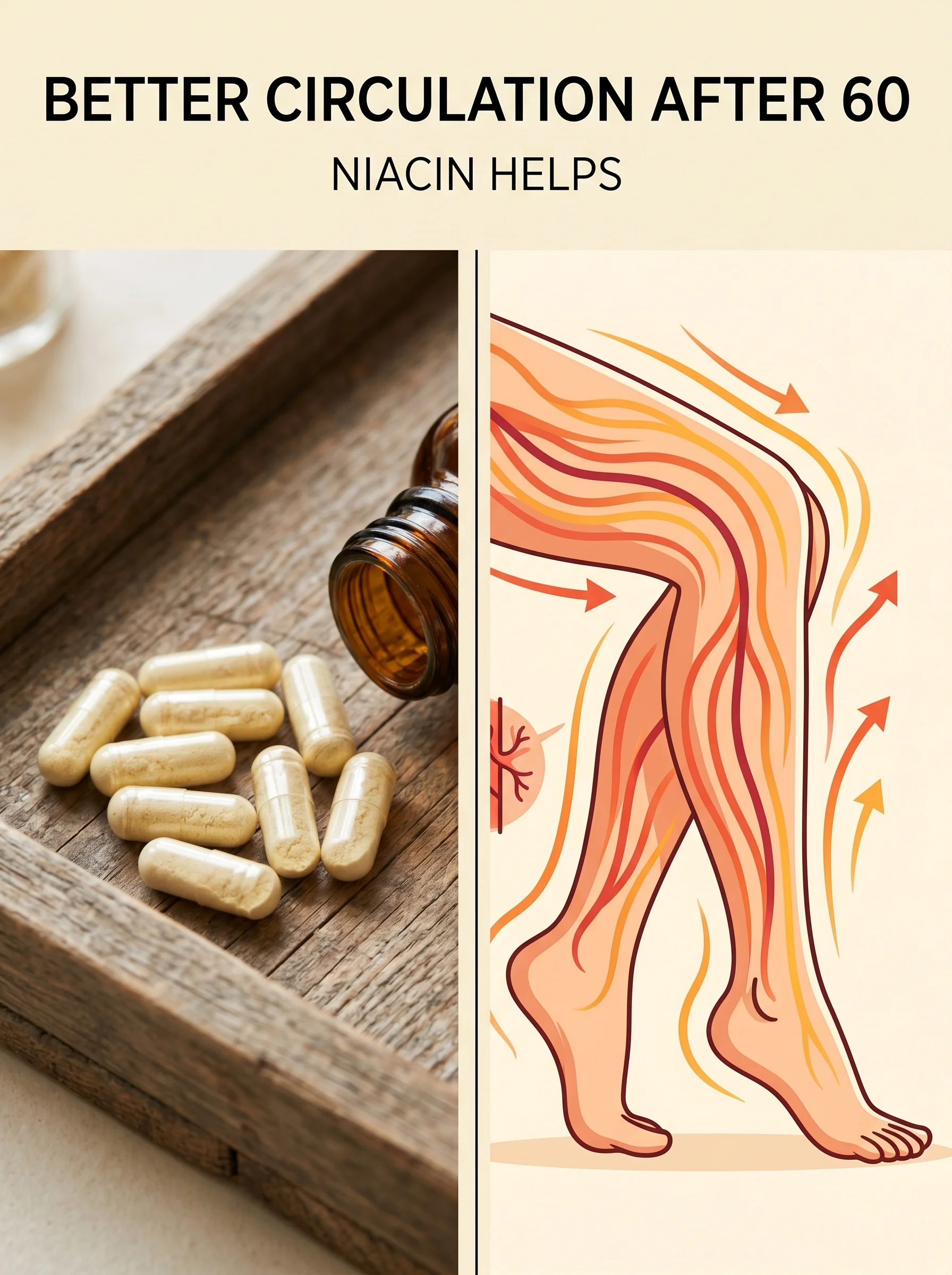
I started researching on my own. And that’s when I came across something surprising. Study after study pointed to a specific B vitamin that affects blood vessel health, and to how many of us over 60 run low on it without ever knowing. It wasn’t some exotic supplement. It wasn’t an expensive drug. It was niacin. Vitamin B3.
Most people associate niacin only with cholesterol, but its niacin benefits reach further than that. Niacin isn’t just a vitamin. It takes part in hundreds of enzyme reactions in your body, more than almost any other vitamin. It’s part of how your body turns food into the energy your cells run on.
Is niacin good for circulation and blood vessels after 60?
This is the question most people over 60 are really asking, and the short answer is yes, the right form can genuinely support circulation. Niacin does three helpful things. First, it relaxes and widens blood vessels so blood can flow more freely. It’s a little like loosening a kinked hose. Second, it calms inflammation in vessel walls, helping them stay flexible. And third, over time it supports healthier arteries that are less likely to narrow.
Research published in Circulation Research has linked niacin to higher levels of a protein called adiponectin, which helps protect blood vessel walls from damage and inflammation. When that protein rises, blood tends to reach the legs and feet more easily, exactly where so many of us first notice trouble.
Niacin also helps keep the inner lining of your blood vessels, the endothelium, soft and responsive. It’s like keeping a hose supple instead of letting it crack and harden. Work from researchers at the Mayo Clinic has reported meaningful improvements in small-vessel blood flow in the legs and feet among people taking niacin, the very areas where circulation problems first show up as we age. If poor circulation is a worry for you, it pairs naturally with the kind of vessel-friendly habits in our look at celery and beet juice to support cleaner arteries.
Which form of niacin gives you the circulation benefits?
This is where most people slip, and it’s why they don’t see any change. There are three types of niacin on pharmacy shelves and only one of them actually supports circulation. This one detail can save you a lot of money and months of frustration.
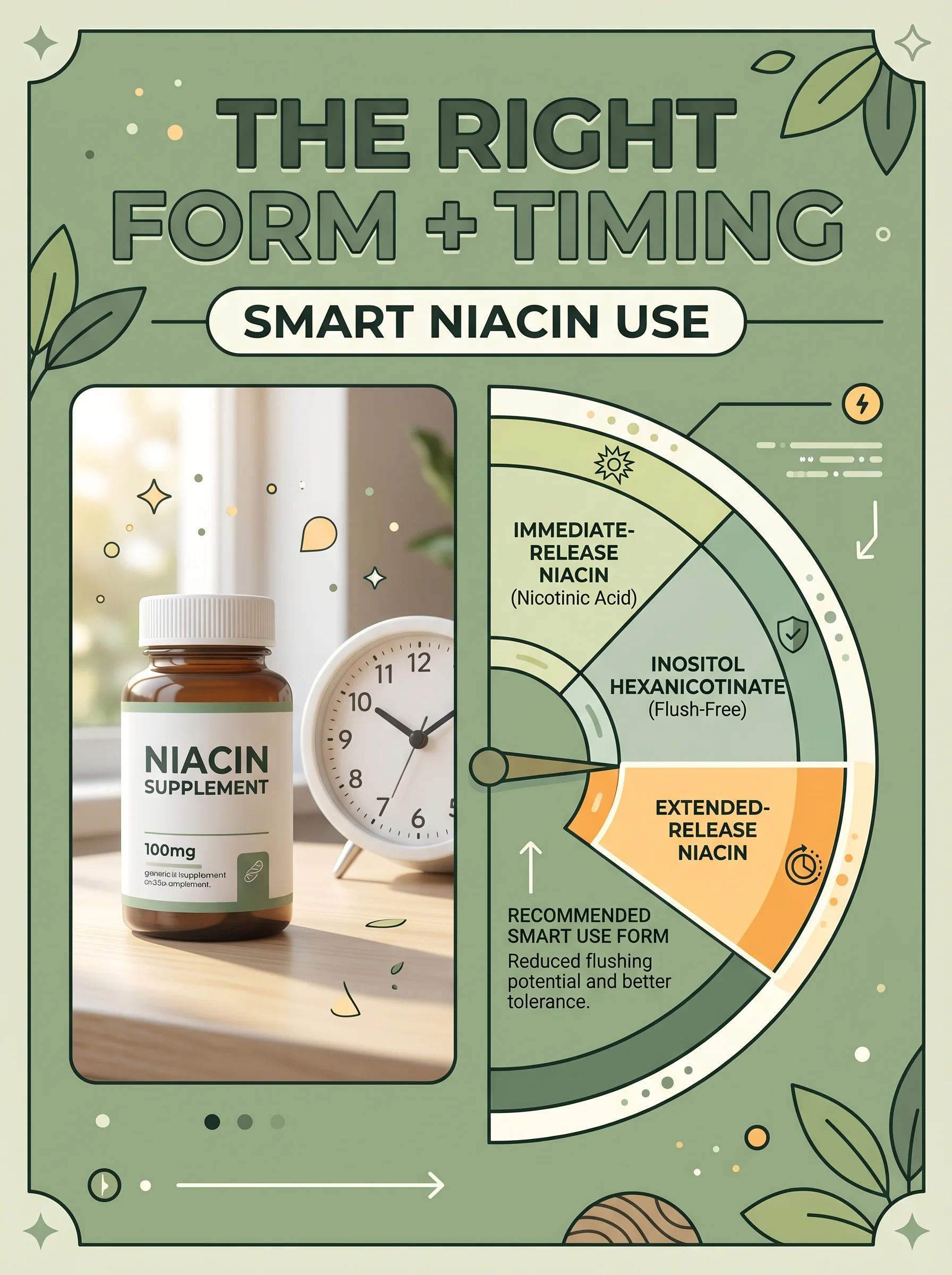
First, there’s “no-flush niacin,” or inositol hexanicotinate. It’s sold as niacin without the side effects. Sounds great, right? The problem is this form doesn’t release enough free niacin into the body. Studies suggest it does very little for circulation. You’re paying for something that mostly won’t help here.
Second, there’s niacinamide, or nicotinamide. This form is lovely for skin and general repair, but it doesn’t widen blood vessels, so it won’t move the needle on blood flow. It’s simply not the one you’re looking for.
Third, and this is the form behind the circulation niacin benefits, nicotinic acid. This is the classic form of niacin, and it’s the one shown to widen blood vessels and support blood flow. If the label doesn’t say nicotinic acid or simply niacin, you’re probably holding the wrong type. Write this down. Check the label. This part is crucial.
Margaret, 71, made exactly this mistake. She bought no-flush niacin because she didn’t want the warmth. She took it for two months, saw nothing, and felt she’d wasted her money. When she switched to nicotinic acid and started doing something I’ll share in a moment, the swelling in her ankles eased over a few weeks. For the first time in years, she could see her ankle bones again.
Which foods are richest in niacin?
The source of niacin matters just as much as the type. The richest sources include chicken, especially the dark meat, turkey, salmon and tuna, peanuts and peanut butter, mushrooms (especially portobello), avocado, green peas, and brown rice.
Here’s something encouraging. Our need for niacin rises only modestly with age, not by huge amounts. That means a few smart food choices can make a real difference without reaching for big doses. Food-first is also the gentlest way to start, and it sits comfortably alongside the everyday choices in our guide to daily habits that keep your heart healthy.
The coffee mistake that blocks niacin
Even eating these foods regularly, you might not be absorbing enough niacin. Why? Because something common can get in the way. And if you have it at breakfast, you may be quietly undoing your good work. It’s coffee.
Too much caffeine can interfere with B vitamin absorption, niacin included. This doesn’t mean you have to give up coffee. It means you space them out. If you drink coffee first thing in the morning, wait at least 30 minutes before eating niacin-rich foods or taking a supplement.
Robert, 68, was doing everything right, eating the right foods and taking the right form, but he wasn’t seeing results. Why? He was drinking three cups of strong coffee at breakfast alongside his niacin-rich meal. When he separated the two and added the morning ritual, his feet grew warm again over a couple of months, and he was sleeping through the night without painful cramps.
What is the 8-minute morning ritual that supports niacin?
One of the simplest ways to support niacin’s circulation benefits is to get your muscles moving first thing. When you move, your leg muscles work like a natural pump. Each contraction pushes blood back toward the heart. It’s like giving the circulation that niacin is already helping a gentle head start, and the best part is you can begin right in bed.
Sit on the edge of your bed the moment you wake up. First, rotate your ankles in circles 10 times in each direction. Then, point and flex your feet 10 times. Next, gently massage your calves with upward strokes for two minutes. Now stand up and march in place, lifting your knees as high as is comfortable, for two minutes. Finish by shaking out your legs and feet for 30 seconds.
Do this before breakfast and before coffee, when you’re about to have niacin-rich foods. You’re essentially switching on the muscle pump and getting your circulation ready for the day.
James, 74, paired this morning routine with niacin-rich foods at the right timing and told us, “After two weeks, I can really feel the difference. My legs don’t feel like lead weights in the afternoon anymore. I’m back to gardening without having to sit down every 10 minutes.”
When to take niacin for best absorption
Timing matters more than people expect. The body tends to absorb and use niacin better when it’s paired with a little healthy fat. That’s why having peanuts or avocado alongside other niacin sources can help.
In the morning, after a little movement, your body is in a good state to use it. Your digestion is waking up and your system is naturally more active. If you’re taking a supplement, take it after the morning ritual with a meal that includes some healthy fat, and at least 30 minutes after coffee. If you’re focusing on food, make your niacin-rich breakfast the first solid meal of the day, with avocado or peanuts.
This sequence, morning ritual, wait 30 minutes, then niacin with a little healthy fat, is the simple rhythm that gets the most from each meal. If clot risk and sluggish flow are on your mind, it dovetails nicely with our roundup of anticoagulant foods that help prevent blood clots.
Is the niacin flush dangerous, or a sign it’s working?
Here’s one of the most-searched questions about niacin, so let’s settle it gently. Nicotinic acid can cause flushing, a warm, pink, sometimes tingly feeling in the skin, usually in the first few weeks. For most people the flush itself is harmless. It’s simply blood vessels widening near the surface, and it tends to ease as your body adjusts. Taking it with food, or starting low and building up slowly, makes it easier to live with.
The flush is not the part to worry about. The dose is. This is where I need to be very clear with you, because the internet is full of people chasing bigger and bigger amounts.
Important safety notes, please read this part
Before you start, please don’t skip this. It matters for your safety. High daily doses of niacin, the kind some people take on their own for circulation or cholesterol, can cause nausea, drops in blood pressure, raised blood sugar, gout flares, and in some cases real liver strain. This is not a “more is better” vitamin. Recent guidance has only made cautious dosing more important, not less.
So please don’t self-dose high-dose niacin. If you take medications for cholesterol, blood pressure, or diabetes, it’s essential to talk to your doctor before starting anything. Niacin can interact with these medicines, especially statins, where the combination can raise the risk of muscle problems. Your doctor may want to adjust doses or check on you more closely. And never stop a prescribed medication to swap in niacin. Think of niacin as a supportive habit alongside your care, not a replacement for it.
For everyday support, your body needs only a small daily amount of niacin to function. The much larger amounts sometimes mentioned for circulation are, in truth, a medical-level treatment, and they belong under medical supervision with periodic blood tests. The good news is that even starting with niacin-rich foods gives your body what it needs to begin supporting better circulation, gently and safely.
Can niacin help repair blood vessel damage over time?
Beyond the day-to-day niacin benefits for blood flow, there’s hopeful research on the longer view. Studies in cardiovascular journals have linked consistent, sensible niacin intake to less arterial stiffness and better endothelial function, that critical inner lining of your blood vessels that helps regulate flow. In other words, niacin may help with more than the surface symptoms of poor circulation. None of this is instant, and none of it replaces medical care, but it’s a reason to be patient and consistent. For another vessel-supportive nutrient often discussed in the same breath, see our piece on NAC for cleaner arteries and clot prevention.
For me personally, the changes came slowly and then felt unmistakable. Within a couple of weeks of following the full routine, morning ritual, right timing, niacin-rich foods kept apart from coffee, I noticed less swelling at my ankles. After a month, I could walk farther without stopping. By the three-month mark, even my doctor remarked on the improvement. The color had returned to my feet. The constant coldness had eased. And that heavy, dragging feeling in my legs had quietly faded.
But the most important change wasn’t physical. It was emotional. I could play with my grandchildren again. I could do the things I love again. I got a little of my independence back, and that’s priceless.
The complete protocol, step by step
- Choose the right form. Look for nicotinic acid on the label, not no-flush niacin or niacinamide. Before using any supplement, talk to your doctor first, especially if you take other medications.
- Lean on niacin-rich foods: chicken, turkey, fish, peanuts, mushrooms, avocado. Make breakfast your most niacin-rich meal.
- Separate coffee from niacin. If you drink coffee, wait at least 30 minutes before niacin-rich foods or a supplement.
- Do the 8-minute morning ritual daily: ankle rotations, foot flexes, calf massage, marching in place, leg shaking. Before breakfast, to switch on the muscle pump.
- Pair niacin with a little healthy fat to help absorption: avocado, peanuts, or a drizzle of olive oil with your meal.
- Be consistent, and be patient. Give your body at least two to four weeks to start adapting.
You don’t have to accept tired legs and poor circulation as an inevitable part of aging.
A gentle closing thought
Our bodies have a real capacity to recover when we give them the right support. Niacin is one of those supports: accessible, well-studied, and genuinely helpful, but only when you use the right form, the right timing, and a sensible dose. Tired, heavy legs aren’t something you simply have to accept. With a little knowledge and a few daily habits, more comfortable, steadier legs could be just a few weeks away. If you’d like more practical, science-minded guidance like this, especially for adults over 60, the newsletter lands in your inbox every Friday.
Frequently asked questions
Which form of niacin actually works for circulation?
Only nicotinic acid, the classic form of niacin, is shown to widen blood vessels and support blood flow. No-flush niacin (inositol hexanicotinate) doesn’t release enough free niacin to help, and niacinamide is good for skin but doesn’t affect circulation. If the label doesn’t say nicotinic acid or simply niacin, you’re likely holding the wrong type.
Is niacin good for circulation and blood vessels after 60?
Yes, the right form can support circulation after 60. Niacin helps widen blood vessels, calms inflammation in vessel walls, and supports the healthy inner lining that regulates flow. Research has linked it to better small-vessel blood flow in the legs and feet. Use food first, and clear higher doses with your doctor.
Is the niacin flush dangerous or a sign it’s working?
The flush, a warm, pink, tingly feeling in the skin, is usually harmless. It’s just blood vessels widening near the surface, and it tends to fade as your body adjusts. Taking niacin with food or starting low helps. The real caution isn’t the flush, it’s high doses, which can strain the liver.
How much niacin is safe to take, and can I take it on my own?
Your body needs only a small daily amount to function. The much larger amounts sometimes used for circulation are a medical-level treatment and can cause nausea, low blood pressure, raised blood sugar, gout, or liver strain. Don’t self-dose high amounts. Use food-based niacin freely, and clear any supplement with your doctor.
Why does coffee block niacin, and what should I do?
Too much caffeine can interfere with B vitamin absorption, including niacin. You don’t have to quit coffee. Just space it out. If you drink coffee first thing, wait at least 30 minutes before eating niacin-rich foods or taking a supplement so your body can absorb more of it.
Is niacin safe to take with my medications?
If you take medications for cholesterol, blood pressure, or diabetes, talk to your doctor before starting niacin. It can interact with these medicines, especially statins, raising the risk of muscle problems. Never stop a prescribed medication to use niacin instead. Treat niacin as a supportive habit alongside your care, under medical guidance.
Share this article