Macros for weight loss: how to set protein, carbs, and fat
Sheenam Midha · Health writer
On this page
Macros for weight loss are a way to organize a calorie target into protein, carbohydrate, and fat. They are not a metabolic password: the best split is one that creates a manageable energy deficit, covers nutrition needs, and is realistic enough to repeat.
Use our macro calculator for a starting estimate. Then use the steps below to understand and adjust the output instead of treating every gram as a clinical prescription.
What macros actually measure
Protein and carbohydrate provide about 4 calories per gram, while fat provides about 9. Alcohol provides energy too, but it is not one of the three required macronutrients. A calculator divides estimated daily calories among those categories.
The precision can be misleading. Your maintenance calories are estimated from equations and an activity factor. Food labels, portions, restaurant meals, activity trackers, fluid shifts, and normal metabolism all add uncertainty. A target of 1,823 calories is not meaningfully more certain than a rounded, usable target.
Why maintenance calories are a moving estimate
Resting-energy equations use inputs such as age, sex, height, and weight. An activity factor then tries to account for movement. Neither step directly measures your full daily expenditure.
People with the same desk job can differ in walking, fidgeting, household work, muscle mass, and training. A wearable adds another estimate; it does not turn the calculation into a laboratory measurement.
Energy needs also change during weight loss. A smaller body generally requires less energy to move and maintain. Some people unconsciously move less as a deficit continues. The old rule that every fixed calorie deficit produces the same weekly loss forever ignores those adaptations.
Use the calculator as a hypothesis. Follow the plan consistently for several weeks, compare average weight and waist, then adjust. That feedback is how an estimate becomes personal.
Different macro splits can produce weight loss
Two diets can contain the same calories and protein with different carbohydrate and fat amounts. Both can support weight loss if the deficit is maintained.
A person who enjoys rice, fruit, and endurance training may prefer more carbohydrate and moderate fat. Someone who feels better with fewer starches may choose more fat within an appropriate calorie total. Neither split has to become an identity.
Medical context matters. Diabetes medicine can make abrupt carbohydrate changes unsafe. Gallbladder, pancreatic, kidney, gastrointestinal, and lipid conditions can influence food choices. Pregnancy and adolescence are not situations for an unsupervised weight-loss calculator.
Judge the split by hunger, energy, digestion, food quality, training, laboratory markers, and adherence. The ratio that looks impressive in an app is useless if you cannot live with the meals.
How to set macros for weight loss
1. Estimate maintenance calories
Start with an equation-based estimate and choose an honest activity level. A desk job plus three short workouts does not usually equal an extremely active lifestyle. The NIDDK Body Weight Planner demonstrates why energy needs also change as body weight changes.
2. Choose a moderate calorie deficit
A smaller deficit is often easier to sustain and less disruptive to training than an aggressive cut. The suitable pace depends on starting weight, health, medications, pregnancy status, age, and history with dieting. Faster is not always safer or more durable.
3. Set protein
Adequate protein helps preserve lean tissue during weight loss and supports fullness. Active adults often start within a range based on body weight, but total body weight can overstate needs at higher body-fat levels. See our protein-intake guide for calculations and cautions.
4. Set enough dietary fat
Fat supports cell membranes, hormone production, and absorption of vitamins A, D, E, and K. Rather than driving it as low as possible, include foods such as nuts, seeds, olive oil, avocado, and oily fish when appropriate.
5. Use carbohydrate for the remainder
Carbohydrate can support training and supplies fiber when it comes from beans, fruit, vegetables, and whole grains. After protein and fat are set, allocate the remaining calories to carbohydrate based on preference, glucose management, and performance.
A worked macro example
Suppose a person chooses 1,800 calories, 120 grams of protein, and 60 grams of fat.
- Protein: 120 × 4 = 480 calories
- Fat: 60 × 9 = 540 calories
- Calories remaining for carbohydrate: 1,800 - 480 - 540 = 780
- Carbohydrate: 780 ÷ 4 = 195 grams
The result is 120 grams protein, 60 grams fat, and 195 grams carbohydrate. It is a planning example, not proof that this is the right intake for you.
Turn the example into meals
Dividing the 120-gram protein target across four eating occasions gives an average of 30 grams each. The meals do not need to match perfectly. Breakfast might have 25 grams, lunch 35, dinner 40, and a snack 20.
Carbohydrate can cluster around training if that supports performance. A rest day may naturally contain less. Fat can vary with food choices as long as the weekly pattern remains reasonable.
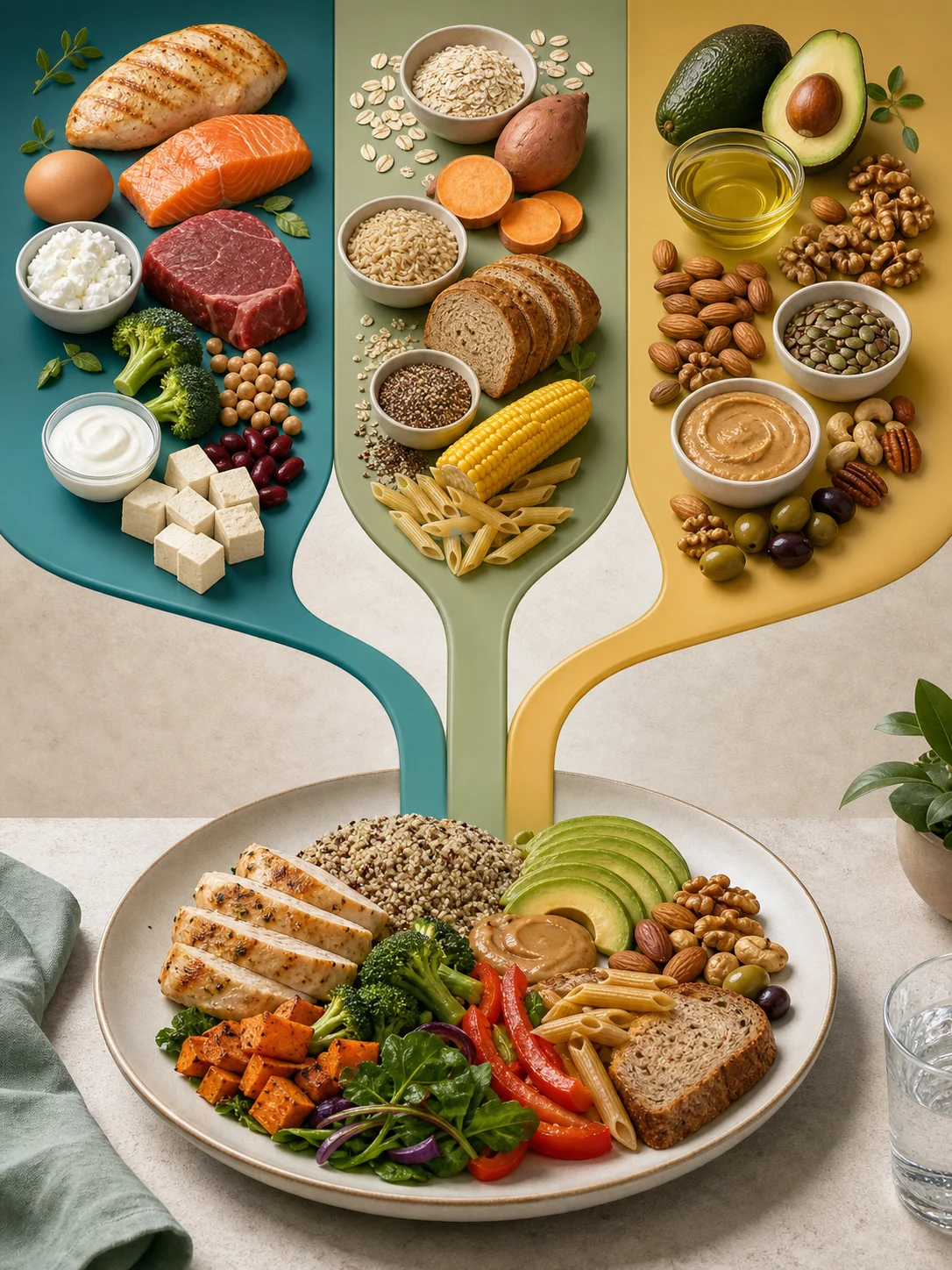
A day could include eggs and yogurt or tofu at breakfast, beans and grain with vegetables at lunch, fruit and a protein-rich snack, and fish, chicken, tempeh, or lentils at dinner. Portions depend on the person’s numbers. Cultural foods do not need to be replaced by a generic fitness menu.
Vegetables and fruit contribute carbohydrate, fiber, and micronutrients. Oils, nuts, seeds, cheese, and sauces can contribute substantial fat in small volumes. Track those foods accurately enough to learn, without pretending the app knows the exact recipe.
Fiber and food quality still matter
Macros do not distinguish lentils from candy or olive oil from butter. The totals can match while fiber, vitamins, minerals, sodium, saturated fat, and fullness differ.
A practical fiber benchmark is about 14 grams per 1,000 calories, adjusted for individual tolerance and medical needs. Increase fiber gradually and drink an appropriate amount because a sudden jump can cause gas or constipation.
Build meals from minimally processed staples most of the time: vegetables, fruit, legumes, whole grains, nuts, seeds, dairy or fortified alternatives, and suitable protein foods. Convenience foods can still fit. Perfection is not required.
Saturated fat, sodium, and added sugar matter to health even when the macro totals are correct. A macro app that ignores them is a calculator, not a dietitian.
How accurate does tracking need to be?
Weighing food for one or two weeks can teach portions, especially for calorie-dense oils, nuts, spreads, cereal, and restaurant-style servings. It does not need to become permanent.
Use raw or cooked database entries consistently. A 100-gram dry rice entry is not the same as 100 grams cooked. For a recipe, add the ingredients, record the final number of servings, and accept that portions will still vary slightly.
Restaurant estimates can be far off because recipes and oil use change. Log a reasonable value and move on. One uncertain meal does not ruin the week.
Do not “earn” food through exercise calories. Most calculators already include an activity estimate, and adding every wearable calorie can double-count movement.
Ranges work better than exact gram deadlines
Set protein as a range, keep fat above a reasonable floor, and let carbohydrate flex. For the 120-gram protein example, a daily range of 110 to 130 may be more livable.
Weekly averages can absorb a birthday meal or a low-appetite day. The goal is not to alternate restriction and compensation. Return to the normal plan at the next meal.
If hitting the target requires eating when uncomfortably full at bedtime, the system is serving the app instead of you. Stop at a normal meal and improve distribution tomorrow.
Alcohol needs to be counted in the energy picture even though it is not assigned as protein, carbohydrate, or fat in the usual macro split. It can also change sleep, appetite, and food choices.
Make the numbers easier to live with
Turn daily macros into meal templates. A meal might include a palm-sized protein food, a high-fiber carbohydrate, generous vegetables, and a measured source of fat. Repeating a few flexible templates reduces tracking burden without requiring identical meals.
Use ranges rather than pass-or-fail numbers. Being within roughly 5 to 10 grams for protein and fat and somewhat wider for carbohydrate is often more practical than reshuffling food at bedtime to hit an exact app target.
How to know whether the plan is working

Compare weekly average body weights across at least several weeks under similar conditions. Waist, hunger, energy, sleep, training performance, digestion, and menstrual function when relevant provide important context. A sudden one-day increase is commonly water, stored carbohydrate, sodium, or food mass rather than new body fat.
If there is no downward trend after several consistent weeks, first audit portions and adherence. Then consider a small calorie change or more activity. Avoid cutting repeatedly based on daily scale noise.
Adequate fluids also affect training and scale interpretation. Our daily water guide explains why a universal eight-glass target does not fit every body or environment.
What a real plateau looks like
Three days without a lower scale number is not a plateau. Sodium, menstrual-cycle changes, carbohydrate intake, constipation, travel, and sore muscles can hold water.
Use daily weights only if they do not cause distress, then compare weekly averages. Otherwise, weigh less often under similar conditions and give the trend more time. Waist measurements every few weeks can add context.
A genuine plateau is a stable trend across several weeks despite reasonably consistent intake and activity. First audit the easy-to-miss items: cooking oil, drinks, weekend portions, restaurant meals, and food eaten while preparing meals.
If adherence is solid, reduce intake modestly or add manageable activity. Do not remove hundreds of calories every time the scale pauses. The smaller body may simply need a revised estimate.
Diet breaks and maintenance practice
A planned period at estimated maintenance can make a long diet easier to manage. It is not a metabolic reset that guarantees faster loss later. It is practice for the way you will need to eat after the deficit ends.
Bring calories up gradually or directly to the new estimate, keep protein and training stable, and expect some water-weight increase as carbohydrate and food volume rise. That change is not automatically regained fat.
Use the period to learn portions without constant loss pressure. Hunger, social events, and training may become easier. Then decide whether another deficit phase is appropriate.
Maintenance is not failure. Keeping a meaningful loss off is an outcome, and it often requires continued habits even when tracking becomes lighter.
When the calorie target is too low
Warning signs include persistent dizziness, fainting, feeling cold, poor concentration, loss of menstrual periods, worsening sleep, declining training, preoccupation with food, and repeated binge episodes.
The response is not to find a more aggressive macro ratio. Increase support and speak with a clinician or dietitian. People taking blood-pressure or diabetes medicine may need treatment adjustment as intake and weight change.
Rapid weight loss can increase the chance of gallstones and lean-mass loss. A slower plan may protect training, nutrition, and adherence.
If weight is falling without trying, do not start a calculator plan. Unintentional loss deserves medical evaluation.
How to stop tracking without losing the structure
Keep two or three repeatable breakfasts and lunches. Learn the portion of protein and calorie-dense fat that fits each. Use a flexible plate pattern at dinner and check body-weight or waist trend less often.
You can return to short-term tracking when portions drift or goals change. The app is a diagnostic tool for the routine, not a lifelong requirement.
Plan for restaurants and celebrations by eating normally beforehand and returning to the routine afterward. Saving all calories for one meal often leads to extreme hunger and less control.
If numbers provoke anxiety or compensatory behavior, use a non-tracking approach with professional support. Weight loss is not worth worsening an eating disorder.
When macro tracking is a poor fit
Pregnancy, adolescence, diabetes medication, kidney disease, eating-disorder history, and medically complex weight change deserve individualized support. Stop and seek help if tracking creates intense anxiety, rigid compensatory behavior, dizziness, fainting, or persistent loss of menstrual periods.
You can lose weight without tracking macros. Plate methods, higher-fiber food swaps, structured meals, and environmental changes may be more sustainable for some people.
Use numbers as temporary tools
Use macros as adjustable guardrails. Start with estimated calories, protect protein and dietary fat, let carbohydrate match preferences and training, and judge the plan by a multiweek trend plus how well you can live with it.
Evidence and review
How this article was checked
Energy and macronutrient guidance checked against National Academies references, NIDDK planning tools, and CDC weight-management guidance. This article has not been independently medically reviewed. Evidence last reviewed Aug 4, 2026.
- NIDDK - Body Weight Planner - Dynamic model for how calorie and activity changes can affect body-weight trends over time.
- National Academies - Dietary Reference Intakes for Macronutrients - Reference ranges and scientific framework for protein, carbohydrate, fat, and fiber.
- CDC - Physical Activity and Your Weight and Health - Public-health guidance on energy balance, activity, and weight management.
- International Society of Sports Nutrition - Protein and Exercise - Evidence-based protein ranges for active adults and resistance training.
FAQ
Frequently asked
Answers
Frequently asked questions
What is the best macro ratio for weight loss?
No single ratio is best for everyone. Weight loss requires a sustained energy deficit, while protein adequacy, minimum dietary fat, fiber, food quality, preferences, and adherence help determine a workable split.
Should I cut carbs to lose weight?
You do not have to eliminate carbohydrate. A lower-carbohydrate plan works for some people, while others train and adhere better with more high-fiber carbohydrate. Total intake and sustainability matter.
How often should I adjust my macros?
Use a multiweek weight trend rather than one weigh-in. If the trend is unchanged for several weeks and adherence is genuinely consistent, make a small adjustment instead of repeatedly rebuilding the plan.
Do I need to hit every macro exactly?
No. Treat targets as ranges. Getting close consistently while eating a varied diet is more useful than forcing exact numbers at the expense of hunger, social life, or nutrient quality.
Share this article