
eGFR levels by age: a chart with important caveats
Sheenam Midha · Health writer
On this page
eGFR levels by age tend to decline across adulthood, but an age chart cannot diagnose chronic kidney disease. eGFR is an estimate built from a filtration marker and personal variables, and the most useful interpretation combines repeat results with urine albumin and clinical context.
Use our eGFR calculator to explore the 2021 CKD-EPI creatinine equation for adults. Your laboratory result should remain the starting point for clinical decisions.
Why eGFR changes with age
Kidney filtration tends to decrease with age, but people vary widely. The NIDDK publishes the following population means from NHANES III:
| Age | Population mean eGFR |
|---|---|
| 20-29 | 116 mL/min/1.73 m² |
| 30-39 | 107 mL/min/1.73 m² |
| 40-49 | 99 mL/min/1.73 m² |
| 50-59 | 93 mL/min/1.73 m² |
| 60-69 | 85 mL/min/1.73 m² |
| 70 and older | 75 mL/min/1.73 m² |
These are group averages, not minimum acceptable values. A younger person can have kidney disease at an eGFR above 60 when urine albumin or another marker shows damage. An older person with a stable result just below 60 and little albuminuria may have a different risk profile, but still deserves proper evaluation.
What the eGFR number represents
GFR describes how much fluid the kidneys’ filtering units clear from the blood over time. Measuring true GFR requires a filtration marker and a timed clinical procedure. Routine care usually estimates it from a blood marker, which is why the “e” in eGFR matters.
The result is reported as milliliters per minute per 1.73 square meters of body-surface area. Standardizing to 1.73 m² makes results easier to compare across adults of different sizes. It also means the displayed value is not always the same as an unindexed clearance used for a specific drug-dosing decision.
Laboratories often report values above a certain level as “greater than 90” rather than an exact number because estimating equations become less precise at higher filtration. A result of 105 should not be treated as measurably better than 98 on the strength of the last digit.
The trend is usually more useful. A stable estimate near a decision boundary asks a different question from a rapid fall over weeks. Always compare dates, creatinine values, illness, medicine changes, and urine findings.
Why creatinine can mislead
Creatinine is produced from muscle metabolism and removed partly through the kidneys. When filtration falls, blood creatinine usually rises. The equation uses that relationship along with age and sex to estimate GFR.
Muscle mass complicates the picture. A muscular adult may generate more creatinine and receive a lower creatinine-based eGFR than actual filtration would suggest. A frail older adult, person with paralysis, or amputee may generate less creatinine, making kidney function look better than it is.
Recent cooked meat intake and creatine supplements can raise creatinine in some circumstances. Heavy exercise may also affect the measurement. Medicines can change creatinine secretion without causing the same degree of change in true filtration.
At the other end, a low creatinine is not proof of exceptional kidneys. It may reflect low muscle mass. This is one reason age averages cannot settle an individual diagnosis.
Do not stop a medicine or supplement from an internet article. Give the full list to the clinician interpreting the result so they can decide whether a repeat or another marker is needed.
What cystatin C adds
Cystatin C is another blood marker used to estimate filtration. It is produced by nucleated cells and is less tied to muscle mass than creatinine, although inflammation, thyroid status, steroid use, smoking, and other factors may influence it.
When eGFR sits near an important decision point, NIDDK recommends considering an equation that combines creatinine and cystatin C. The two markers have different sources of error, so using both can improve accuracy for many people.
A cystatin C test is not required after every creatinine result. It can be useful when body composition makes creatinine questionable, when a diagnosis needs confirmation, or when the result would change treatment, referral, or medication decisions.
The combined result can move above or below the creatinine-only estimate. That is not necessarily a laboratory conflict. It is the reason the second marker was requested.
How eGFR is calculated
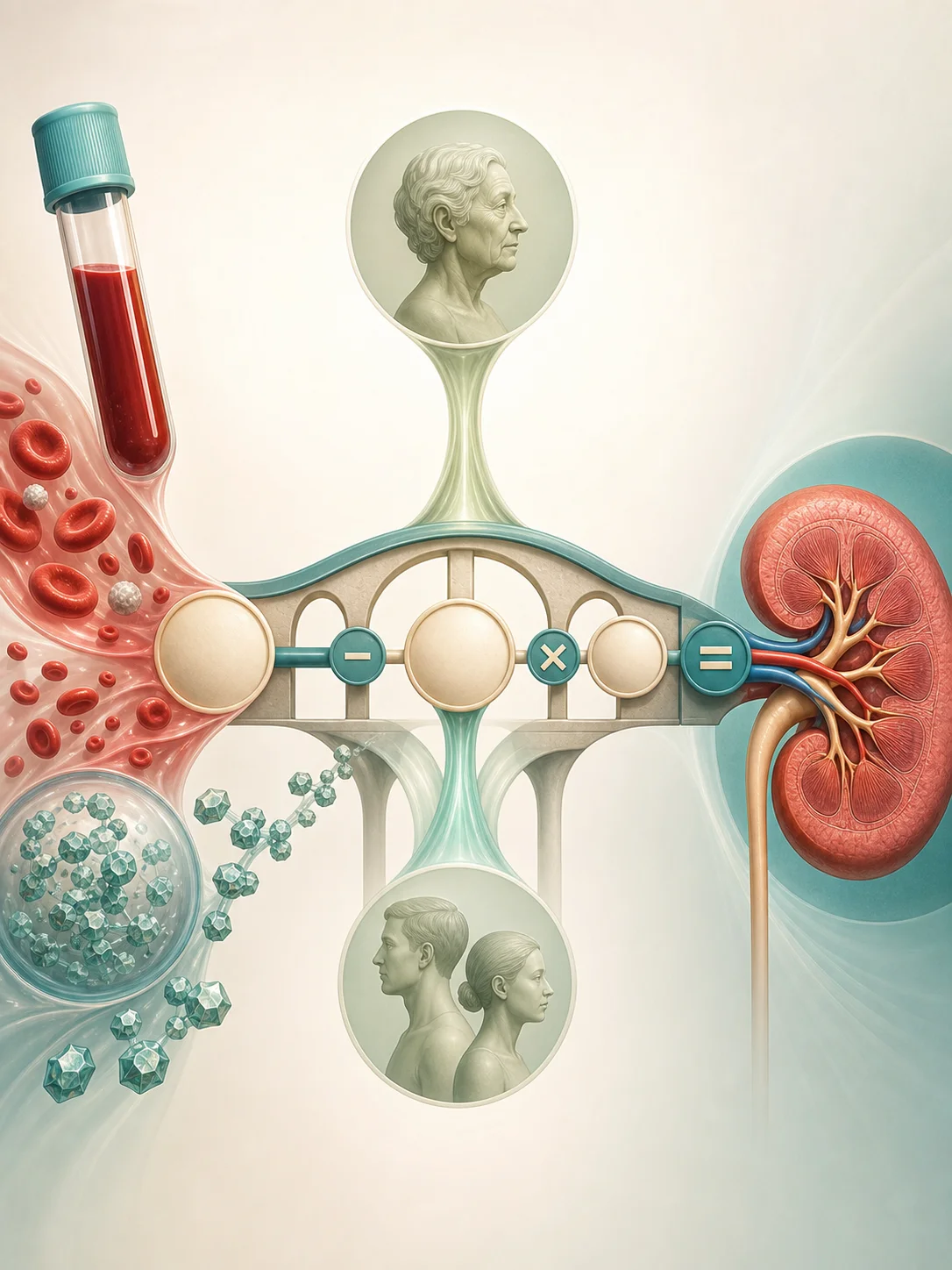
The current 2021 CKD-EPI creatinine equation uses serum creatinine, age, and sex. It does not use race. Creatinine is convenient, but muscle mass, diet, supplements, amputation, paralysis, frailty, and acute illness can change it independently of kidney filtration.
Inside the equation, your creatinine is compared with a sex-specific threshold (0.7 mg/dL for women, 0.9 mg/dL for men). Values below and above that threshold get different exponents, because creatinine and filtration don’t follow a straight line. An age term then lowers the estimate a little each year, and a small multiplier applies for women. You don’t need to work the powers by hand; our eGFR calculator does it.
A worked example shows how much age and small creatinine changes matter. A 60-year-old woman with creatinine 1.2 mg/dL gets an eGFR of about 52. At 40, with the same creatinine, it’s about 59. At 60 with creatinine 1.0, it’s about 64. The curve is steep enough that you should copy the creatinine value exactly as printed, decimals included.
Units trip people up more than the math. US labs report creatinine in mg/dL; most other countries use µmol/L, where the number is much bigger. 1.0 mg/dL is about 88.4 µmol/L, so divide µmol/L by 88.4 to get mg/dL. Typing 106 into a calculator expecting mg/dL describes an impossible creatinine and sends eGFR toward zero. Check the unit next to your result before you enter anything.
When a result sits near an important decision point, the NIDDK notes that combining creatinine with cystatin C improves accuracy and reduces bias compared with either marker alone.
eGFR categories and chronic kidney disease
| G category | eGFR | General description |
|---|---|---|
| G1 | 90 or higher | High or normal; CKD only if another marker of damage is present |
| G2 | 60-89 | Mildly decreased; CKD only if another marker is present |
| G3a | 45-59 | Mildly to moderately decreased |
| G3b | 30-44 | Moderately to severely decreased |
| G4 | 15-29 | Severely decreased |
| G5 | Below 15 | Kidney failure range |
CKD generally requires an abnormality for at least three months. Urine albumin-to-creatinine ratio is the second major marker because filtration and kidney damage are related but not identical.
Urine albumin completes the basic picture
Healthy kidney filters generally keep most albumin in the blood. Albumin in urine can signal damage even when eGFR remains above 60. The usual screening test is a urine albumin-to-creatinine ratio, often shortened to UACR.
Albuminuria is grouped broadly as A1, A2, and A3. A1 is below 30 mg/g, A2 is 30 to 300 mg/g, and A3 is above 300 mg/g. Results need clinical confirmation because hard exercise, fever, infection, menstruation, marked high blood pressure, and high glucose can cause a temporary rise.
G and A categories work together. A person with G2 filtration and A3 albuminuria can have meaningful kidney disease risk despite an eGFR above 60. A person with G3a and little albuminuria has a different risk pattern.
Ask for both results rather than relying on a kidney “stage” taken from eGFR alone. Blood pressure, diabetes, cardiovascular disease, cause of kidney injury, and rate of change refine the prognosis further.
Acute kidney injury and chronic kidney disease are different
Chronic kidney disease requires evidence that kidney abnormality persists, generally for at least three months. Acute kidney injury can develop over hours or days during severe illness, dehydration, infection, urinary blockage, surgery, or exposure to a kidney-stressing medicine.
A sudden eGFR fall is not safely explained by age. The equation was designed around relatively stable creatinine; when creatinine is changing quickly, the estimate lags behind the current situation.
Suppose eGFR was 82 six months ago and is 48 during an illness with vomiting. That may represent acute injury, chronic disease that was not previously present, or both. The person needs timely clinical assessment and repeat testing, not a conclusion from the G3a row alone.
After recovery, the result may return toward baseline or remain lower. The follow-up establishes what was temporary and what persists.
How to read a trend
Line up the dates, eGFR, creatinine, urine albumin, and circumstances of each test. Use the same laboratory when practical, although modern standardized creatinine methods should be broadly comparable.
A change from 88 to 84 over a year may sit within ordinary biological and measurement variation. A pattern of 88, 74, 61, and 49 under stable conditions deserves much more attention. The rate, consistency, and clinical setting matter more than any one age average.
Do not overreact to a one-point move across a category boundary. An eGFR of 60 and 59 are not biologically different enough to create an instant disease transformation. Chronicity, albuminuria, and the broader trend decide the meaning.
Keep blood pressure and glucose results with the kidney record. Diabetes and hypertension are common causes of kidney disease, and their control affects future risk.
Medication dosing and contrast decisions
Kidney function influences the dose or suitability of many medicines. Some dosing instructions use eGFR, while older labels and certain clinical settings use estimated creatinine clearance from the Cockcroft-Gault equation. These numbers are not interchangeable.
Body size can matter because routine eGFR is indexed to a standard surface area. A pharmacist or clinician may convert the value for a particular decision. Do not do that conversion to change a prescription on your own.
Before imaging with contrast, surgery, or a new medicine, give the team your recent kidney results and history. The decision considers the type of contrast or medicine, current kidney function, urgency, hydration status, and alternatives.
Over-the-counter pain medicines, supplements, and herbal products belong on the list too. “Natural” does not guarantee kidney safety.
What supports kidney health?
Manage blood pressure and diabetes with the plan agreed with your clinician. Avoid tobacco. Use prescribed kidney-protective medicine consistently and report side effects rather than stopping silently.
Stay normally hydrated, but do not force water to chase a higher eGFR. If dehydration lowered the result, replacing an appropriate amount of fluid can help. If chronic damage lowered it, excess water does not rebuild filtration and may be unsafe in heart or kidney failure.
Ask before starting a high-protein diet when kidney function is reduced. Protein advice depends on the stage of disease, nutrition status, diabetes, dialysis, age, and treatment goals.
Keep follow-up appointments. Kidney disease often causes few symptoms early, so blood and urine trends carry information that the way you feel may not.
How to interpret one unexpected result
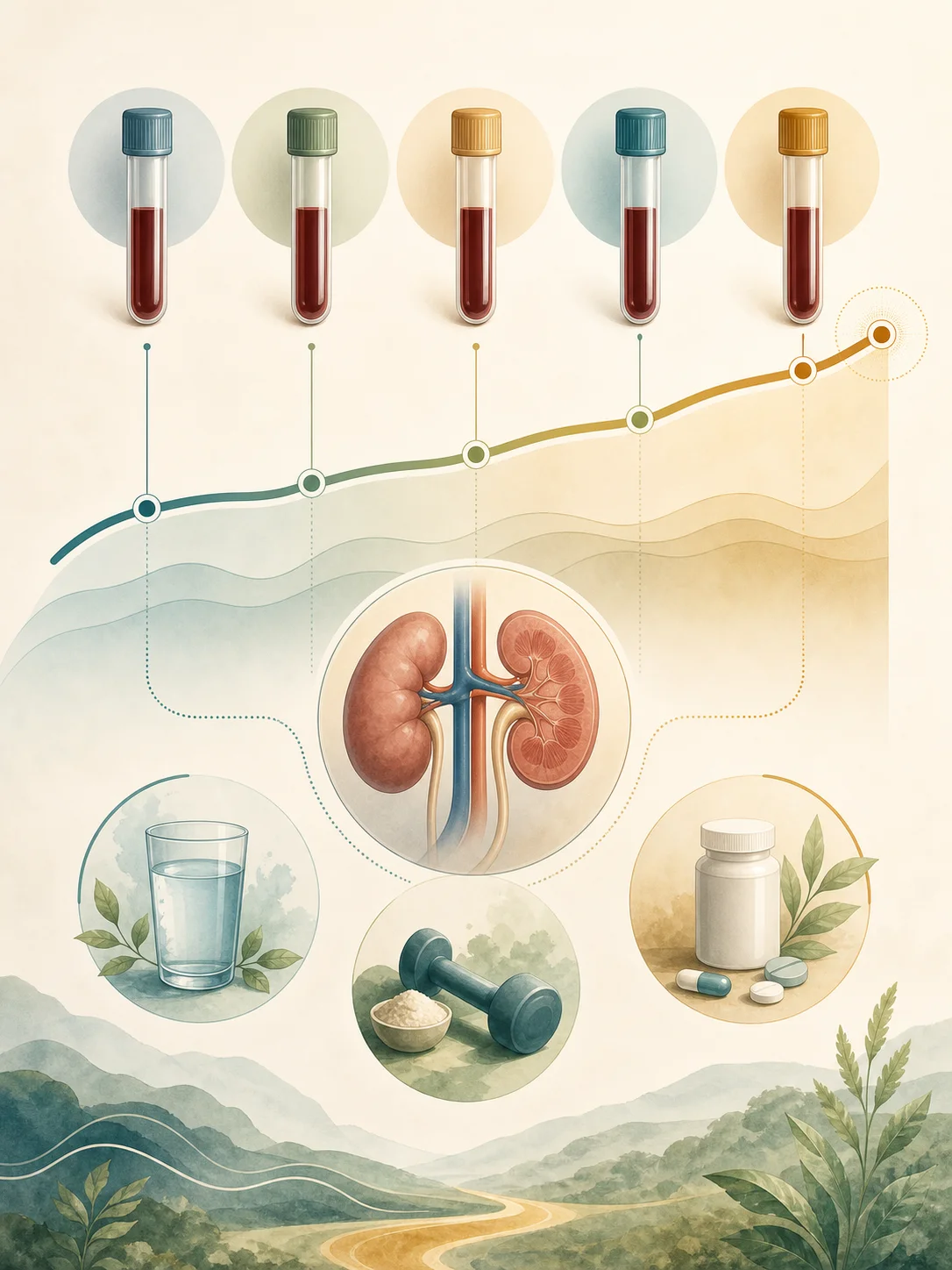
Check whether you were acutely ill, dehydrated, hospitalized, or taking a medicine or supplement that affects creatinine. Compare with previous results and ask whether urine albumin was measured. Do not assume drinking excessive water will “flush” the kidneys or normalize a genuinely reduced filtration rate.
Ask which equation the laboratory used. Current adult practice favors race-free CKD-EPI equations. If an older report used a race coefficient, values may not be directly comparable without knowing the method.
Our guide to how much water you should drink explains why fluid needs vary and why overhydration can also be harmful.
When to seek medical advice
Arrange follow-up for a new low eGFR, a meaningful downward trend, urine albumin, blood in urine, swelling, difficult-to-control blood pressure, or a family history of kidney disease. Seek urgent care for very low urine output, severe swelling with breathing trouble, confusion, or symptoms during an acute illness.
Foamy urine alone does not diagnose albuminuria, and normal-looking urine does not rule it out. Use a laboratory urine test when kidney damage is the concern.
Age is context, not an explanation
Age explains part of the expected variation in eGFR, but it should never be used to dismiss a result. Trends, urine albumin, repeat testing, and the limitations of the equation determine what the number means.
Evidence and review
How this article was checked
Population averages, CKD criteria, and equation limitations checked against NIDDK and National Kidney Foundation resources. This article has not been independently medically reviewed. Evidence last reviewed Aug 4, 2026.
- NIDDK - Demographics and eGFR Accuracy - NHANES population-average eGFR by age and current race-free equation context.
- NIDDK - Clinical Measurements and eGFR Accuracy - Limitations of creatinine-based estimates and situations where they are less reliable.
- National Kidney Foundation - CKD-EPI Creatinine Equation 2021 - Current adult creatinine-based equation and clinical-use notes.
- NKF/ASN - Race-free eGFR - Joint statement on the race-free 2021 CKD-EPI creatinine equation.
- NIDDK - Assess Urine Albumin - Recommended UACR testing and interpretation of albumin levels in urine.
FAQ
Frequently asked
Answers
Frequently asked questions
What is a normal eGFR for my age?
Population averages decline with age, but your result must be interpreted with urine albumin, repeat testing, medical history, and the equation used. An average is not a personal cutoff.
Does an eGFR below 60 always mean chronic kidney disease?
CKD generally requires an eGFR below 60 or another marker of kidney damage for at least three months. One result during illness or dehydration cannot establish chronicity.
Can muscle mass change eGFR?
Yes. Creatinine comes from muscle metabolism, so very high or low muscle mass can make creatinine-based eGFR less representative of actual filtration.
Share this article


